
SayDuo: AI Language Learning
Terasofts JSCEducation
4.02.00 Reviews
- Version
- 1.3.1
- Installs
- 100.00K
- Age Rating
- Everyone
Screenshots
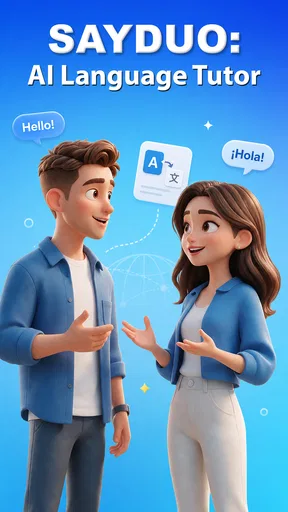
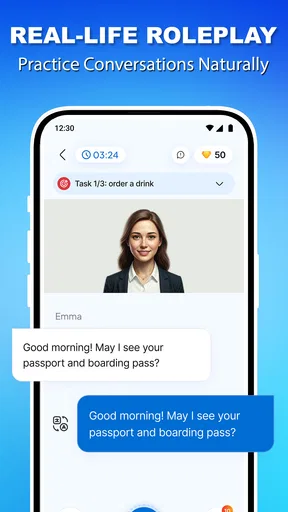

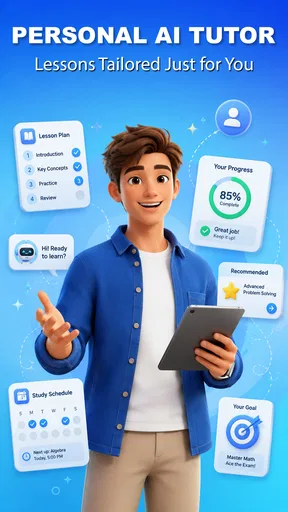
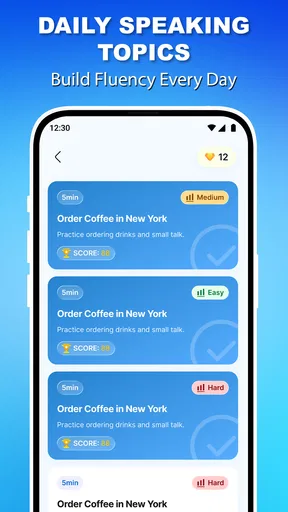
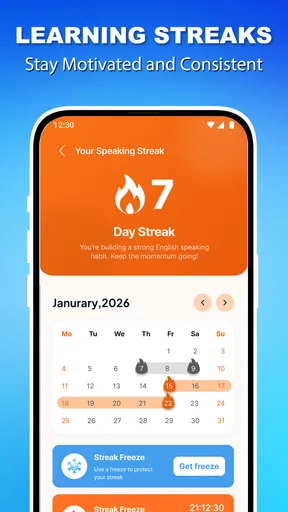
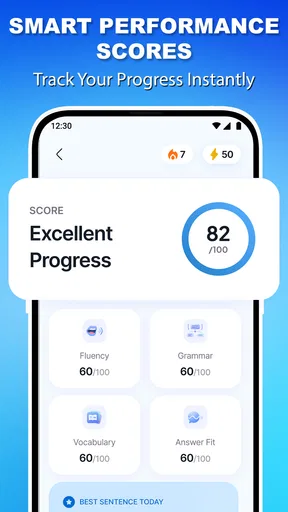
Our Review of SayDuo: AI Language Learning
 Analysis by Appyee
Learning to speak a language is easy to postpone because the usual study tools make progress feel distant. SayDuo: AI Language Learning takes a more immediate route: it puts speaking practice at the center and uses artificial intelligence to help learners work on pronunciation and fluency. After spending time with it, I found the strongest part was not the novelty of talking to an AI, but the way the app lowers the barrier to starting a short practice session.
That distinction matters. Many language apps are excellent at vocabulary recognition, translation, or grammar drills, yet leave you unprepared for the moment you must actually say something aloud. SayDuo is aimed at that uncomfortable gap. It belongs in the education category, is free to install, and is developed by Terasofts JSC. Its store summary presents it as a daily speaking companion, and that is the fairest way to understand it: not a complete language course, but a focused tool for turning passive knowledge into spoken practice.
My overall impression is positive, with an important condition. The app can earn a lasting place on your phone if you use it as a small, repeatable speaking routine. It is less convincing as your only learning resource, especially if you need a carefully sequenced curriculum, extensive explanations, or a full set of reading and writing exercises. The first week is naturally engaging; the real test is whether its speaking practice remains useful once the initial curiosity wears off.
What SayDuo feels like during the first week
The first sessions are appealing because they remove some of the social pressure associated with speaking practice. Talking to another person can feel intimidating when you are unsure of your grammar or accent. An AI conversation gives you room to pause, restart, and try again without worrying about holding up a classmate or disappointing a tutor. For a hesitant learner, that private rehearsal space is a meaningful advantage.
I would especially recommend beginning with short sessions rather than treating the app like a classroom. A few spoken exchanges are enough to reveal where you hesitate: greetings, verb endings, question forms, or the simple problem of finding a word quickly. If you attempt an overly ambitious session immediately, the experience can become less about communication and more about trying to produce perfect sentences. The better approach is to speak first, notice the friction, and use the next session to address one recurring weakness.
Pronunciation practice is most valuable when you use it as feedback rather than as a score to chase. If the app indicates that a sound or phrase needs work, repeat it at a slower pace and then place it into a complete sentence. Isolated repetition can make a learner good at copying one line without improving spontaneous speech. SayDuo makes more sense when you move from correction to meaning: say the phrase again, then use the same structure to describe something from your own day.
A realistic first-week routine would be a short session after breakfast, another while waiting for public transport, or a final attempt before bed. The point is not to fill every spare minute. Speaking practice benefits from regular exposure, and a routine that feels almost too easy to skip is usually more sustainable than a long session that turns study into a chore. I found the app more useful when I treated it as a daily warm-up rather than a test of language ability.
There is also a practical benefit for learners who understand more than they can say. You may recognize a sentence when reading it but freeze when asked to create a similar one. Speaking directly forces retrieval, which is a different skill from recognition. That makes the app a sensible companion to flashcards or lessons, because it gives those remembered words a chance to become active language.
Why the novelty helps, and where it stops helping
The AI element gives the opening experience a conversational feel that ordinary flashcards cannot provide. Instead of tapping through isolated answers, you have to formulate a response. That creates useful pressure, but it also exposes the limits of an AI-based practice tool. A conversation can feel engaging without necessarily being a complete lesson. If you finish a session without identifying what to review next, the activity may be enjoyable yet educationally vague.
My advice is to keep a small personal note beside the app. Write down two or three expressions that caused trouble, then deliberately bring them back into your next conversation. This simple workflow turns an open-ended exchange into a learning loop: attempt, notice, record, reuse. It is one of the easiest ways to get more value from SayDuo than a learner who simply opens it, talks, and closes it.
The app is also a good fit for people who dislike being watched while practicing. A classroom or language exchange offers human interaction, but it can make mistakes feel public. SayDuo gives you a private place to build confidence before using the language with real people. That does not replace real conversation; it makes real conversation less intimidating.
Whether it still earns attention after the first month
The month-to-month value depends on whether you use the app for maintenance or expect it to supply your entire education. For maintenance, it has a clear role. Speaking skills fade when they are not used, even if vocabulary remains familiar. Short, repeated conversations can keep sentence patterns accessible and help prevent the common experience of understanding a language but being unable to respond quickly.
I see the strongest long-term use case in between larger study sessions. Perhaps you attend a weekly class, work through a textbook, or learn with videos. SayDuo can occupy the days when you do not have enough time for a full lesson. A brief spoken exchange keeps the language active and gives you a chance to test what you learned elsewhere. This is more realistic than expecting one app to handle pronunciation, grammar, vocabulary, listening, reading, writing, and cultural context equally well.
For someone preparing for travel, the app can help rehearse predictable situations such as ordering food, asking for directions, introducing yourself, or explaining a simple problem. The useful trick is to practice variations instead of memorizing one ideal answer. After rehearsing a basic request, change the place, time, quantity, or reason. That forces flexible speaking and makes the exercise closer to what happens outside the app.
For a busy worker, the value is different. You may not need a formal course every day, but you may need to keep a professional vocabulary available. A short session can be used to explain a project, describe a schedule, or practice a polite request. I would still verify important industry terminology elsewhere, but the speaking practice itself can help with speed and confidence.
Students can also use it before an oral presentation. Rather than reading the presentation repeatedly, summarize each section aloud in your own words. If you cannot explain an idea without looking at the page, that is useful information. SayDuo is better suited to this kind of active rehearsal than passive rereading, although it should not be treated as a substitute for a teacher checking the accuracy and appropriateness of academic language.
The maintenance habit that makes the difference
Long-term success with this app is less about enthusiasm and more about reducing setup friction. Choose one dependable moment in your day and attach speaking practice to it. Keep the goal narrow: one topic, one pronunciation issue, or one conversational function. A vague goal such as “improve my language” is difficult to act on, while “practice describing yesterday” gives the session a clear shape.
Another useful habit is alternating familiar and unfamiliar material. Familiar topics make it easier to speak fluidly and build confidence. New topics expose gaps and prevent you from repeating the same comfortable phrases. If every session is easy, you may be maintaining fluency without expanding it. If every session is difficult, you may start avoiding the app. A balanced rotation gives the tool a better chance of remaining useful beyond its initial appeal.
Because the app is free to install, it is easy to try without making a large commitment. There are in-app purchases ranging from ninety-nine cents to twelve dollars and ninety-nine cents per item, so I would approach optional spending with a specific purpose. Before paying for anything, use the free experience long enough to decide whether you actually return to speaking practice. A purchase cannot solve a habit problem, and it is better to know that your routine works before adding cost.
The app is rated for Everyone, which makes it approachable for a broad audience. That does not mean every learner will find the same level of challenge appropriate. Younger users or beginners may benefit from a parent, teacher, or structured course that supplies progression and checks understanding. Adults with a clear target can usually decide more independently how to shape each practice session.
Where the maintenance burden and fatigue appear
The main burden is not installation or complexity; it is supplying your own structure. A traditional course often tells you what to study next. With a speaking-focused AI app, you have to decide whether you are practicing pronunciation, speed, vocabulary, confidence, or a particular real-world situation. That freedom is convenient at first, but it can become tiring when you open the app without a plan.
Repeated conversation can also become predictable. If your sessions keep circling around introductions and basic daily topics, you may feel fluent within a narrow comfort zone while avoiding the language you actually need. I would periodically define a concrete challenge, such as describing a recent decision, comparing two options, or explaining a problem without translating word by word. These tasks create more useful resistance than endlessly repeating easy exchanges.
AI feedback deserves a measured level of trust. It can be helpful for noticing pronunciation patterns and encouraging you to speak, but automated feedback is not the same as a patient human teacher who understands your background, intended meaning, and recurring grammar mistakes. When a correction feels confusing, compare it with a reliable dictionary, course, or teacher rather than assuming the app is always right. This is particularly important when a phrase has several natural alternatives.
Another source of fatigue is the temptation to measure progress only by how comfortable a session feels. Familiar prompts can produce a pleasant sense of improvement, but real progress also includes handling unfamiliar wording, recovering after a mistake, and understanding different speaking speeds. Use the app to create those challenges deliberately. Otherwise, it may become a confidence exercise without enough stretch.
Some learners will simply prefer human interaction. If your main goal is spontaneous dialogue, humor, cultural nuance, or negotiation with another person, a tutor, conversation group, or language exchange is the better primary choice. SayDuo can prepare you for those settings, but it cannot provide every quality of a human relationship. Likewise, if you want detailed grammar lessons and a visible course path, a structured education app may offer clearer progression.
How it compares with familiar alternatives
Compared with flashcard apps, SayDuo is stronger at retrieval under speaking pressure and weaker at systematic vocabulary review. Flashcards are efficient when you need to learn a large number of words and revisit them on a schedule. They rarely reveal whether you can assemble those words aloud. I would pair the two rather than choose one: use flashcards for memory and SayDuo for turning memory into speech.
Compared with a textbook or video course, it offers more immediate practice and less explanation. A course can show why a sentence works, introduce grammar in an orderly sequence, and build toward a defined level. SayDuo is more flexible for a spare moment, but that flexibility means you must create some of the curriculum yourself. Learners who need a clear syllabus should keep a structured resource at the center.
Compared with a tutor, the app is more private, convenient, and repeatable, while a tutor is better at interpreting meaning, correcting several layers of an answer, and adapting to personal goals. The two can complement each other well. Practice a topic privately first, then use a human lesson to test whether your speech works in a genuine exchange.
Compared with simply talking to yourself, SayDuo adds a responsive element and makes it harder to avoid producing an answer. Self-talk is still useful, especially for describing your surroundings or narrating routine tasks, and it costs nothing. The app becomes worthwhile when you need external prompts, pronunciation attention, or a more deliberate practice setting.
Who should use it, and who should skip it
I would recommend SayDuo to learners who already know some basic words and structures but hesitate when speaking. It is also a good choice for people who have limited time, dislike public mistakes, or want a daily bridge between formal lessons and real conversation. Travelers can use it for scenario rehearsal, workers can practice concise explanations, and returning learners can use it to reactivate a language that has become rusty.
Complete beginners may still enjoy it, but they should not expect conversation alone to explain every unfamiliar word or grammatical pattern. Pairing it with beginner lessons will make the experience less frustrating. Advanced learners should judge it by the quality of challenge available to them. If the conversations remain too easy or fail to address specialized vocabulary, a tutor or targeted speaking group may provide more useful pressure.
I would skip it as a primary choice if your priority is writing accuracy, exam preparation, detailed grammar instruction, or a comprehensive progression from beginner to advanced study. Its purpose is narrower and more practical: getting you to speak, helping you notice pronunciation issues, and keeping spoken language active. That focus is a strength when it matches your need and a limitation when it does not.
The current version is 1.3.1 and requires Android 8.0 or later. Those details make it sensible to check compatibility before planning a routine around it, particularly if you use an older device. With more than one hundred thousand installs and a 4.0 average from around five hundred ratings, it has enough public adoption to suggest that the concept is reaching real learners, while the rating also fits my balanced impression: useful and approachable, but not a universal replacement for every language-learning method.
My long-term verdict on SayDuo
After the novelty fades, SayDuo earns its place when you give it a specific job. That job is not “teach me a language by itself.” It is “make me speak regularly, notice where I struggle, and rehearse useful situations before they matter.” Framed that way, the app has lasting value. It addresses a common weakness in language study and does so in a private, low-pressure format.
The most effective routine is modest: open it regularly, choose one speaking target, reuse difficult phrases, and occasionally raise the challenge with an unfamiliar topic. Keep a structured course, dictionary, flashcard system, or human conversation partner nearby when you need explanation and depth. This combination prevents the app from becoming either a novelty or a repetitive comfort zone.
I like that the free entry point makes experimentation easy, and I appreciate the emphasis on speaking rather than another cycle of passive tapping. I also think users should be honest about the effort involved. The app can make practice more accessible, but it cannot create fluency without repeated use, and AI feedback should be treated as guidance rather than final authority.
My recommendation is to try it if speaking confidence is the missing piece in your current routine. Give it a fair test by using it consistently and with a clear purpose, not by judging it after one entertaining conversation. If you return to it because it helps you speak when you otherwise would not, it has earned permanent space on your phone. If you need a complete course, expert correction, or rich human exchange, let another resource lead and use SayDuo only as a supporting practice tool.
Verdict
Strengths of SayDuo: AI Language Learning
- Short AI conversations make speaking practice easy to fit into a busy day.
- Personalized dialogue topics can make practice feel more relevant and engaging.
- Voice-based interaction helps build confidence beyond text-only language exercises.
- Immediate corrections can highlight mistakes while the conversation is still fresh.
- Useful for practicing everyday phrases in a lower-pressure environment.
Limitations of SayDuo: AI Language Learning
- AI feedback may occasionally misunderstand accents, slang, or intended meaning.
- Advanced learners may find the conversation depth and vocabulary somewhat limited.
- Some features or extended practice options may require a paid subscription.
- Reliable internet access is needed for most AI conversation functions.
- It may not provide the structured grammar progression of a full language course.
Similar Picks in This Category
View All
Duolingo: Language Lessons
Duolingo4.7

Google Classroom
Google LLC2.8

Unacademy: Learn & Crack Exams
Unacademy3.2

Bible App for Kids
Life.Church4.4

Cake - Learn English & Korean
Cake Corp.4.7

Brainly: AI Homework Helper
Brainly4.5
Frequently Asked Questions
What is SayDuo: AI Language Learning, and how does it work?
SayDuo: AI Language Learning is an app designed to help users practice a new language through AI-powered conversations and interactive exercises. Instead of relying only on vocabulary lists, it encourages you to communicate in realistic situations, receive feedback, and repeat difficult phrases. The experience is aimed at learners who want flexible practice sessions that can complement, rather than replace, a structured language course.
Which languages can I learn with SayDuo?
The languages available in SayDuo may depend on the current version of the app, your device, and the learning content provided by the developer. Before downloading, check the official App Store or Google Play listing for the latest supported language list. This is especially important if you are studying a less commonly supported language, since conversation features, pronunciation practice, and lesson depth may vary between languages.
Is SayDuo suitable for complete beginners?
SayDuo can be useful for beginners because AI practice allows you to learn at your own pace and revisit phrases whenever necessary. However, users with no previous language experience may benefit from first learning basic pronunciation, greetings, and sentence structure. The app is most effective when you actively respond, review corrections, and practice consistently instead of treating the conversations as a passive translation tool.
Does SayDuo provide corrections for grammar and pronunciation?
The app is designed to provide AI-supported language practice, which may include suggestions related to wording, grammar, or conversational responses. The exact correction features can differ according to the selected language and the app version. AI feedback should be treated as helpful guidance rather than an infallible teacher, so it is worth checking important explanations against reliable language resources or a qualified instructor.
Is SayDuo free to use, and does it require an internet connection?
SayDuo may offer free access to some features while reserving additional lessons, conversation time, or advanced tools for a subscription or in-app purchase. Review the pricing details shown in your region before starting a trial, paying attention to renewal terms. Because AI conversations generally require communication with online servers, an active internet connection may also be necessary for the main learning functions.
